- Ireland's Competitiveness Challenge 2026
- The Chair presents to the third annual Competitiveness Summit of Ministers hosted by Intel
- Bulletin 26-2: IMD World Competitiveness Rankings 2026
- ESRI publishes new research on SME Financing
- ESRI publishes new research on AI adoption among Irish SMEs
- Bulletin 26-1: Public Investment in Transport Infrastructure: A Competitiveness and Productivity Perspective
- Appointment of new Chair of the National Competitiveness and Productivity Council
- Bulletin 25-5: Benchmarking the Performance of Ireland’s Public Administration, 2024
- NCPC Welcomes Publication of Accelerating Infrastructure Report and Action Plan
- Budget 2026 and Competitiveness: Navigating Uncertainty
- NCPC Welcomes Government's Action Plan on Competitiveness and Productivity
- Call for Expressions of Interest - Member of the National Competitiveness and Productivity Council
- Bulletin 25-4: IMD World Competitiveness Rankings
- Ireland's Competitiveness Challenge 2025
- The Chair presents to the second annual Competitiveness Summit of Ministers hosted by the Taoiseach
- Bulletin 25-3: The Competitiveness Implications of Post-Pandemic Learning Losses
- Bulletin 25-2: Re-estimating Ireland’s International Competitiveness Performance
- Retrospective Review, 2020-2023
- NCPC's South-East Regional Seminar
- Bulletin 25-1: Developments in Ireland's National Productivity Statistics
- The Government Response to Ireland’s Competitiveness Challenge 2024
- Budget 2025 and Competitiveness: Investing in Ireland’s Future Prosperity
- NCPC Chair attends the Competitiveness Summit
- Ireland's Competitiveness Challenge 2024
- Bulletin 24-4 IMD World Competitiveness Rankings
- Bulletin 24-3 Competitiveness and the Housing Market in Ireland
- NCPC's Mid-West Regional Seminar
- NCPC Welcomes DETE-ESRI Joint Economic Research Programme Seminar
- Bulletin 24-2 Ireland’s Competitiveness and Productivity Framework
- ESRI Publish Working Paper of DETE ESRI Joint Research Programme
- Bulletin 24-1 Re-estimating Ireland’s International Innovation Performance
Ireland's Competitiveness Challenge 2026
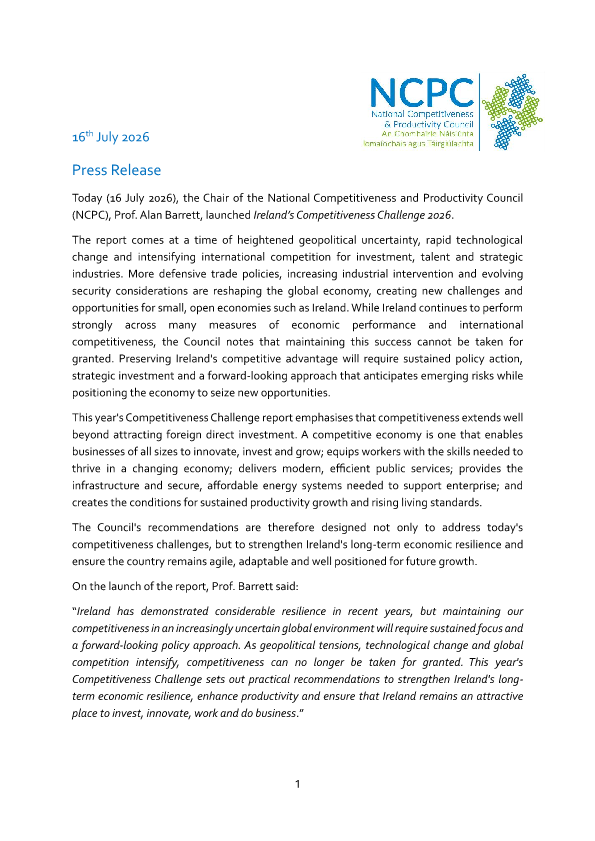
The National Competitiveness and Productivity Council (NCPC) is pleased to publish Ireland’s Competitiveness Challenge 2026 report. The high-level details from the Challenge report were presented on the 13th of July to the Competitiveness Summit of Minsters.
As in previous years, this years Competitiveness Challenge report for 2026 is grounded in the Council's Competitiveness and Productivity Framework and focuses on the key factors shaping Ireland's long-term economic performance. The six areas examined reflect both recent economic developments and the interconnected challenges facing Ireland's competitiveness, productivity, and resilience in an increasingly uncertain global environment. These include economic resilience and energy security, the cost of doing business, public sector reform, labour market developments and AI, and the strategic opportunities presented by Ireland's EU Presidency. The report highlights the need for targeted action to address rising business costs, invest in competitiveness-enhancing reforms, tackle infrastructure deficits, strengthen economic resilience, and prepare the workforce of the future through continuous learning and skills development.
Ireland’s Competitiveness Challenge 2026 report makes 19 targeted and actionable recommendations to Government aimed at strengthening Ireland's competitiveness, productivity, and economic resilience while positioning the economy to capitalise on future opportunities and navigate emerging challenges.
These strategic challenges are:
-
Strengthening economic resilience in response to increasing global uncertainty and structural change.
-
Enhancing energy security as a foundation for sustainable competitiveness and growth.
-
Addressing the high cost of doing business and improving the operating environment for firms.
-
Delivering public sector reform to improve efficiency, responsiveness, and service delivery.
-
Preparing the labour market for future challenges and opportunities, including the impact of artificial intelligence and technological change.
-
Leveraging Ireland's EU Presidency as an opportunity to influence European competitiveness, resilience, and economic policy priorities.
The full report and the press release can be accessed below.
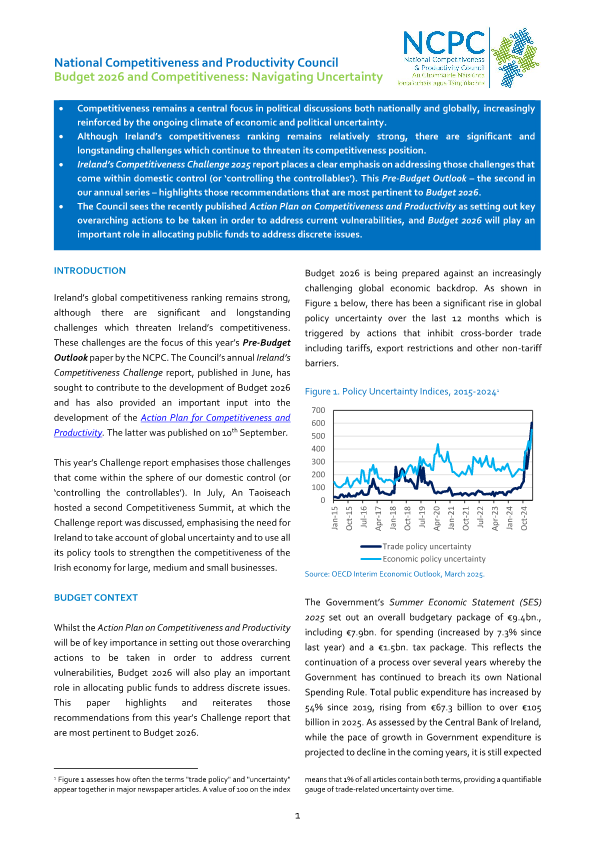
The National Competitiveness and Productivity Council is pleased to announce the publication of Budget 2026 and Competitiveness: Navigating Uncertainty paper. This publication aims to emphasises that competitiveness continues to play a cent...
Whilst it is inevitable that a given Budget will be characterised by a focus on immediate priorities, it also plays a significant role in shaping our broader fiscal approach, and so the objective of this paper is to specifically highlight t...